If you have been a CISO for more than a few years, you have watched this movie before. A platform announces a massive acquisition. The press covers the price. The analysts cover the strategy. Your account rep calls to tell you how it simplifies everything. And somewhere in your stack, a decision you have been putting off just got more complicated.
Last week, CrowdStrike announced it will acquire Zscaler in an all-stock transaction valued at roughly $43.9 billion. It is one of the largest cybersecurity acquisitions on record. If regulators and shareholders approve, it will close in the second half of CrowdStrike’s fiscal year 2028.
The headline is not what matters to you. What matters is what this deal tells you about where the market is going and what it means for the decisions you are making right now.
What the deal does
CrowdStrike has spent years building the Falcon platform outward. Endpoint, identity, cloud. As Forrester’s Madelein van der Hout put it, “Endpoint, identity and cloud are already inside Falcon. The network was the biggest gap, and Zscaler was the biggest network asset still for sale.” This deal closes that gap.
The promise is a closed loop. Falcon’s device telemetry meets Zscaler’s inline traffic enforcement, so a risk signal on an endpoint can drive an access decision on the network in the same beat. The combined dataset, trillions of endpoint events plus 750 billion daily Zscaler transactions, feeds CrowdStrike’s SafeMind models. One platform, one data layer, one Falcon Flex contract.
That is a compelling story if you already live inside Falcon. It is a more complicated story if you do not.
The part that should give you pause
We have been in the room when deals like this land, and the risks that matter are the ones that hit your environment, not the acquirer’s balance sheet. Analysts flagged them within hours.
Latency. Zscaler’s value has always been performance. Traffic inspected inline across 200-plus service locations without slowing users down. Any infrastructure consolidation risks the thing customers bought Zscaler for in the first place. As van der Hout noted, “Every location it consolidates is a latency question for the users routed through it.”
Integration of equals. CrowdStrike has historically bought capabilities and bolted them onto Falcon. Zscaler is not a capability. It is a company with its own cloud, its own channel, and its own founder. Integrating two clouds, two go-to-market motions, and two cultures is a different order of problem. And it becomes your problem when roadmap timelines slip.
Lock-in and the mixed-vendor reality. When asked what the deal means for customers who want another endpoint or SASE provider, CrowdStrike’s CEO emphasized the single-agent strategy. That is an answer that serves a platform narrative. It is not an answer for you if you are running SentinelOne or Microsoft Defender for Endpoint alongside Zscaler today. Analysts are already advising buyers to get written support commitments, lock in service locations and data residency, and add change-of-control clauses that let you renegotiate or exit if the product or price shifts post-close.
The combined company will start with more than $10 billion in ARR and a cross-sell motion aimed squarely at the 8,000 Zscaler customers who are not yet CrowdStrike customers. Expect the account teams to arrive with that pitch soon. Expect it to come wrapped in the language of simplification.
The pattern the deal reveals
Step back from this single transaction, because the pattern underneath it matters more than the deal itself.
Security is consolidating around a small number of mega-platforms, each racing to own endpoint, identity, network, and the AI layer that ties them together. The CrowdStrike-Zscaler deal does not invent that trend. It accelerates it.
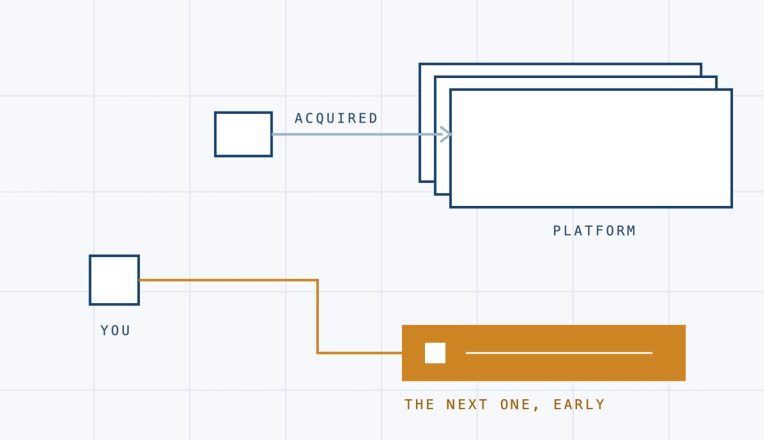
But consolidation has a second, quieter effect that matters more to you. The platforms are not inventing the future. They are buying it. Every defining capability on Falcon’s roadmap arrived through an acquisition of a company that, a few years earlier, was small, emerging, and unknown to most buyers. The platforms consolidate. The emerging companies create. And the advantage accrues to the teams that met the emerging companies early, while they were still growing, while the roadmap was still responsive, and while the relationship was still with the founders building the product.
Think about it. Zscaler was once a three-year-old startup with a radical idea, that security belongs inline in the cloud, not bolted to a firewall in a data center. The teams who met Zscaler early, while the product was still being shaped and their feedback still carried weight, gained an advantage the rest of the market spent a decade catching up to. CrowdStrike just paid $44 billion for the result.
The defenses the AI era demands are being built right now by companies three or four years old. Not by the platforms consolidating around yesterday’s architecture. The companies solving AI-agent governance, non-human identity, post-quantum readiness, and runtime-reachable vulnerability remediation are not the ones issuing $44 billion in stock. They are the ones the platforms will eventually acquire, at a premium, after the advantage has already been spent by the teams who adopted them early.
The question is not whether to consolidate. The question is whether you meet the next Zscaler before or after the platform does.
What an introduction gives you
This is the gap deals like this one open up. When the giants consolidate, two things happen at once. The platforms get louder, and the genuinely emerging companies, the ones building to the current threat instead of retrofitting to last decade’s, get harder to hear above the noise.
ATICO exists to put you in the room with those companies early, while they are still growing and while meeting them still matters. We are a private network of former CISOs, CIOs, and CTOs, based in Austin, who find, vet, and introduce the one emerging company we would bet on for each problem you are trying to solve. We do this independently, on four dimensions: architecture, scalability, financials, and leadership. And we work under one rule. We never represent two companies that compete. When several solve the same problem, we evaluate them side by side and represent only the one we believe is best. The result is that we have no reason to steer you, and you meet the winner of a bakeoff you did not have to run yourself.
That model matters more, not less, in a consolidating market. Here is what an introduction actually gives you.
You meet the company while it is still growing, and while your input still shapes it. The companies that will define the next wave of security are on our index now, vetted, scored, and introduced to you while the roadmap is still responsive to your needs. You meet the founders directly. Your feedback carries weight. You build the relationship before the company is on every shortlist. The alternative is meeting them later, folded into a platform contract, at a price the acquirer sets, with the roadmap already locked. That is the difference between shaping the product and inheriting it.
You get there before the incumbents acquire the advantage. Early adoption is not a risk to manage. It is the advantage itself. The teams that adopted Zscaler five years ago did not bet on a vendor. They bet on a capability the market had not priced in yet. Our job is to find the companies at that same stage today, for the problems on your roadmap this year. Retiring VPNs and VDI. Cutting SIEM cost without losing visibility. Governing AI agents and non-human identities. You get the head start, and the diligence to defend it.
You keep a real choice. A platform pitch tells you what you get by consolidating. It does not tell you what you give up. Our independent diligence gives you an honest second option for every priority, with the technical and business context to decide whether the platform or the emerging company wins each category. You are not locked into a narrative someone else wrote.
You get a relationship, not a report. Intelligence for you, not the market. A curated introduction to the one vetted company that fits each priority. Private briefings with the founders behind the product. Access to advisors who have made the decision you are about to make. It is the kind of input that does not show up in a vendor’s pitch deck, and the kind that gets harder to find as the market narrows.
The bet you actually have to make
The CrowdStrike-Zscaler deal is a reminder that the security market is moving in two directions at once. Upward, toward a handful of integrated platforms. And outward, toward a frontier of emerging companies building to threats the platforms have not caught yet.
Both are real. Both belong in your strategy. The mistake is assuming one is safe and the other is risky.
We have made this call ourselves, and here is what we have learned. The real choice is between two risks, and only one of them can be evaluated and managed upfront. Locking into a consolidating platform before you have seen what the emerging companies can do is a bet made on assumption. Betting on a vetted emerging company, introduced early while it is still growing, with independent diligence and honest caveats, is a bet made on evidence. It is the same bet the early Zscaler customers made. And it is the one CrowdStrike just paid $44 billion to catch up to.
We exist to make the bet an informed one, and to make sure you are on the right side of the next acquisition instead of the one reading about it.
If you are weighing what the CrowdStrike-Zscaler deal means for your roadmap, whether to consolidate onto Falcon, hold the line with best-of-breed, or find the emerging company that solves the problem neither giant has prioritized, that is exactly the conversation we are here to have. Bring us the problem. We will bring you the one company we would bet on.