


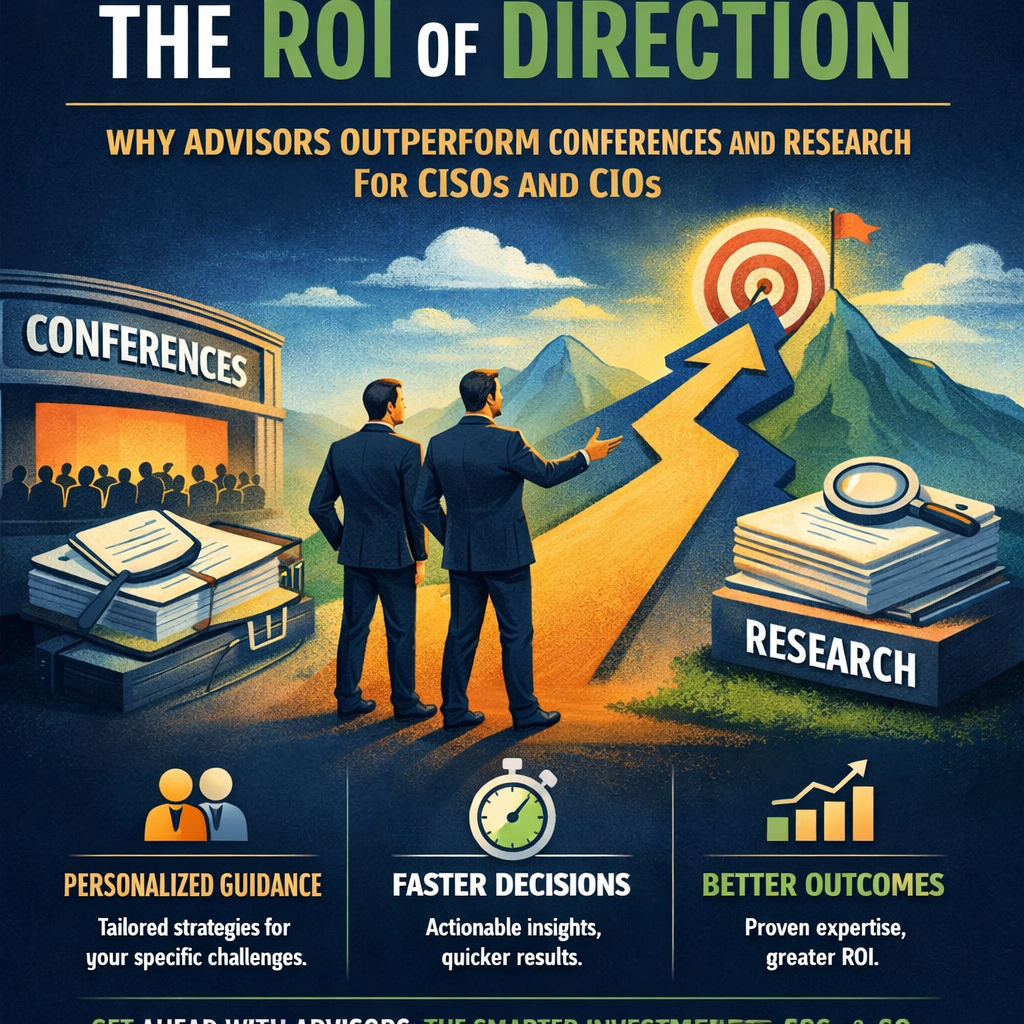
Introduction: A Familiar Budget Question—With the Wrong Framing
Every CIO and CISO eventually faces the same question during annual planning: “Where should we invest to stay ahead?”
The default answers—industry conferences, analyst subscriptions, and peer networking groups—feel safe. They are familiar, defensible, and easy to justify to the board. But familiarity does not equal return on investment.
In a constrained budget environment, the real question is no longer how much information we can access. We are drowning in information. The critical metric is how quickly and accurately leaders can convert insight into decisions. Executives are paid to decide, not to research. ROI is maximized when spend reduces decision latency and execution risk—not when it simply increases information volume.
When we evaluate strategic guidance through the lens of decision acceleration, the ROI of traditional channels begins to diverge sharply from the value of dedicated advisory.
The Hidden Economics of Conferences
Conferences remain valuable for brand exposure, team building, and peer connection. Yet, from a pure ROI perspective, they are among the most expensive and inefficient ways to acquire strategic direction.
Industry data shows that a single in‑person conference typically costs $1,500 to $4,000 per attendee once registration, travel, lodging, and incidentals are included. Most senior leaders attend two or three major events per year, pushing the typical annual spend per leader to between $10,000 and $20,000 [latestcost.com, globalconference.ca, linkedin.com].
But the hard costs are just the tip of the iceberg. That figure completely excludes executive time. With average CISO and CIO hourly costs ranging from $100 to $185 per hour [salary.com, salaryexpert.com], a three‑day conference quietly adds thousands more in opportunity cost.
The more significant limitation, however, is structural. Conference content is inherently generalized, heavily vendor‑influenced, and entirely disconnected from your specific operating reality. The primary output is exposure and networking. Any insight gained must still be translated, prioritized, and defended back home. When framing the value to the board, conferences are categorized merely as "learning." They offer low decision acceleration and absolutely zero outcome accountability.
Conferences optimize exposure, not direction.
Analyst Research: Expensive Validation, Slow Conversion
Analyst firms play a distinctly different role. They provide structured research, market framing, and external validation—which can be incredibly valuable in procurement negotiations or when defending a strategy to the board.
But this value comes at a steep premium. Verified pricing data shows median Gartner buyers spend roughly $80,000 annually, with role‑based CIO, CISO, and executive programs regularly ranging from $66,000 to well over $120,000 per year [vendr.com, online.ogs.ny.gov].
The challenge with analyst research is not the quality of the data—it is the friction of conversion. Analyst output is designed to be broadly applicable across thousands of enterprises. Because the primary output is research and benchmarks, the relevance to your specific environment is only moderate.
To get value out of a $100,000 subscription, CIOs and CISOs must still:
- Interpret dense findings and reports.
- Map generalized trends to their specific industry and risk profile.
- Translate abstract frameworks into actionable, funded roadmaps.
In practice, this shifts the highest “integration cost” back onto the executive. It requires a high time investment for interpretation, introducing delay, ambiguity, and sometimes analysis paralysis. The accountability remains indirect, and the board-level value is simply "validation."
Advisors: A Different ROI Equation
Strategic advisors—whether independent consultants, fractional executives, or advisory boards—operate on a fundamentally different model.
Market pricing for experienced IT and cybersecurity advisors typically ranges from $200 to $300 per hour, or $3,000 to $20,000 per month on a flexible retainer. This places the annual spend for consistent, high-level advisory guidance between $36,000 and $72,000 for most mid‑market and growth-stage enterprise use cases [cynomi.com, cycoresecure.com, workstreet.com].
While the hard cost is often lower than a premium analyst subscription, cost alone drastically understates the ROI.
Advisors are not optimizing for information delivery. They are optimizing for context compression, decision velocity, and execution alignment. They enter the engagement already understanding your regulatory pressures, board expectations, and budget constraints—and they shape their guidance accordingly. The time required from the executive is low-to-moderate, yet the decision acceleration is incredibly high. Furthermore, advisors carry direct outcome accountability.
Why This Matters Specifically for CISOs
CISOs operate under increasing board scrutiny, regulatory exposure, and personal accountability. Cybersecurity is no longer an IT function; it is treated as a critical enterprise risk—a shift heavily reinforced by regulators and agencies such as CISA [cisa.gov].
In this high-stakes environment, strategic advisors help CISOs:
- Translate deeply technical risks into clear, board‑level financial language.
- Prioritize security controls against actual, contextualized threat exposure rather than theoretical best practices.
- Avoid massive over‑investment driven by vendor hype cycles.
For a CISO, ROI is not measured in the volume of tools adopted or reports read. It is measured in risk reduction per dollar spent and time‑to‑decision under pressure.
Why This Matters Specifically for CIOs
CIOs are tasked with balancing cost transparency, operational resilience, and business enablement. Boards increasingly expect technology leaders to explain why investments were prioritized, not simply what was purchased.
Strategic advisors give CIOs an external, experience‑based reference point to:
- Validate complex transformation roadmaps.
- Challenge entrenched internal assumptions and legacy thinking.
- Accelerate difficult trade‑off decisions regarding technical debt and innovation.
This aligns perfectly with emerging board expectations that IT and security investments be framed as value and resilience platforms, rather than traditional cost centers [forrester.com].
Strategic Guidance ROI Comparison
To visualize this dynamic, consider how these three channels stack up across the dimensions that actually drive business value:
|
Dimension |
Conferences |
Analyst Research (e.g., Gartner) |
Strategic Advisor / Advisory Board |
|
Typical Annual Spend |
$10K–$20K (2–3 events) |
$66K–$120K+ |
$36K–$72K |
|
Cost Structure |
Variable, event-based |
Fixed subscription |
Flexible retainer or hourly |
|
Primary Output |
Exposure & networking |
Research & benchmarks |
Contextualized decisions |
|
Relevance to Environment |
Low–Moderate |
Moderate |
High |
|
Time Required from Exec |
High (travel + sessions) |
High (interpretation) |
Low–Moderate |
|
Decision Acceleration |
Low |
Moderate |
High |
|
Outcome Accountability |
None |
Indirect |
Direct |
|
Board-Level Value |
“Learning” |
“Validation” |
“Execution & risk reduction” |
Conclusion: Direction Is the Highest‑Return Asset
When viewed side‑by‑side, the ROI distinction becomes undeniably clear:
- Conferences deliver inspiration.
- Analysts deliver validation.
- Advisors deliver decisions.
The question for growth-stage CISOs and CIOs is no longer whether conferences or research firms provide value—they absolutely do. The real question is whether those investments are sufficient when the mandate from the board is speed, clarity, and accountability.
In volatile threat and regulatory environments, decision latency is the most expensive risk of all. Even modest reductions in time‑to‑strategy or time‑to‑execution can easily offset the entire cost of an advisory engagement.
Advisors do not replace information. They replace indecision. In an environment where leadership success is measured by outcomes, not attendance or subscriptions, direction delivers the highest return on investment.


Leave a Comment